How to Use AI in Tax Planning for Clients

• July 14, 2026

Featured Image

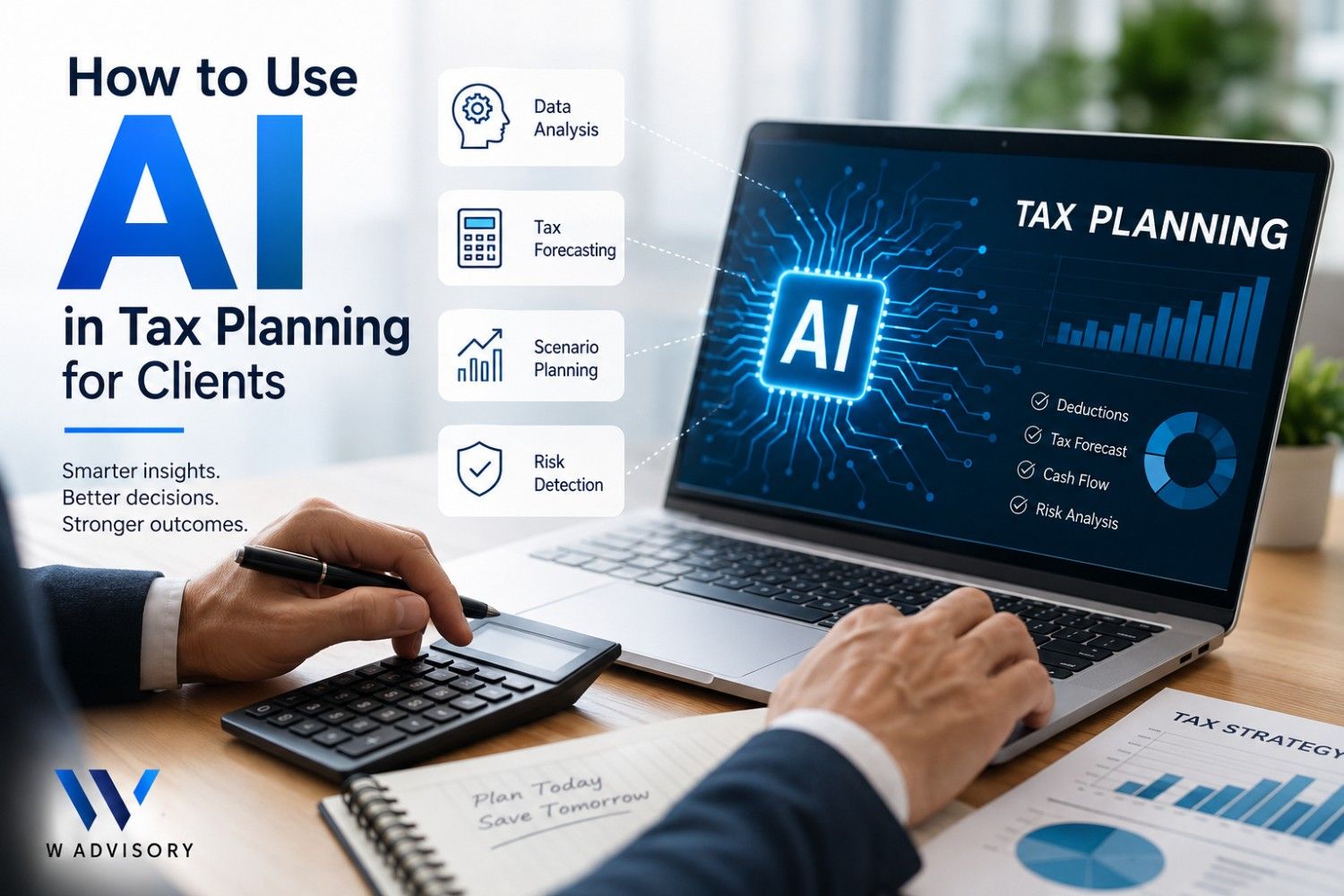
Artificial intelligence is changing how businesses analyse financial information, forecast tax obligations and prepare for important decisions. For accountants and advisers, AI can reduce repetitive work, identify patterns across large datasets and support more proactive conversations with clients.

However, effective tax planning is not simply a matter of entering financial information into an AI tool and accepting its recommendations.

Australian tax law is complex, regularly updated and highly dependent on each client’s circumstances. AI can support the tax planning process, but it should not replace professional judgement, accurate records or advice from a qualified tax professional.

The most effective approach combines reliable technology with human experience. AI performs the data analysis, scenario modelling and administrative work, while an experienced adviser reviews the results, considers the relevant legislation and develops a strategy suited to the client’s broader financial and business goals.

What Is AI in Tax Planning?

AI in tax planning refers to the use of artificial intelligence, machine learning, automation and advanced data analysis to help assess a client’s financial position and identify potential tax planning opportunities.

These systems may analyse accounting transactions, payroll records, expenses, income patterns, asset purchases and historical tax outcomes. They can then help advisers find unusual transactions, forecast future liabilities and compare the potential effects of different financial decisions.

Common examples include:

  • Automatically categorising income and expenses
  • Identifying transactions that may require further review
  • Forecasting taxable income and tax instalments
  • Modelling alternative business or investment scenarios
  • Monitoring potential compliance issues
  • Summarising complex financial information
  • Preparing preliminary tax planning reports

The Australian Taxation Office also uses data and analytics to gain insights and deliver more targeted services. This means businesses should expect tax administration to become increasingly data-driven and digitally connected.

How Can AI Improve Tax Planning for Clients?

1. Organising Financial Data More Efficiently

Good tax planning begins with complete and accurate financial information.

AI-supported accounting platforms can review and categorise large numbers of transactions much faster than a person could manually. This can reduce time spent on data entry and help advisers focus on higher-value activities such as strategy, forecasting and client consultation.

For example, an AI system may flag:

  • Transactions with missing descriptions
  • Potentially duplicated expenses
  • Incorrectly categorised purchases
  • Unusual changes in business expenditure
  • Personal expenses recorded in business accounts
  • Transactions that require supporting documentation

This does not remove the need for bookkeeping controls or professional review. It helps direct attention towards areas where an error or opportunity may be present.

2. Forecasting Tax Liabilities Earlier

Many businesses only determine their final tax position after the end of the financial year. By that stage, the opportunity to implement certain tax planning strategies may have passed.

AI-powered forecasting can use current and historical financial data to estimate:

  • Expected annual revenue
  • Projected taxable profit
  • PAYG instalment requirements
  • GST liabilities
  • Payroll-related obligations
  • Company tax liabilities
  • Available business cash after tax

These forecasts can be updated throughout the year as financial conditions change.

Earlier visibility gives business owners more time to manage cash flow and discuss suitable strategies with their adviser. It may also reduce the risk of receiving an unexpected tax bill.

3. Modelling Different Tax Planning Scenarios

One of the strongest applications of AI in tax advisory services is scenario modelling.

Instead of considering only one possible outcome, advisers can compare several alternatives. For example, a business owner may want to understand the potential tax and cash-flow implications of:

  • Purchasing equipment now or in a later financial year
  • Paying a dividend or retaining profits
  • Making additional superannuation contributions
  • Hiring employees or engaging contractors
  • Changing the timing of income or expenditure
  • Selling or retaining a business asset
  • Restructuring business operations

AI can help calculate and compare these scenarios efficiently. The adviser must then determine which assumptions are valid and whether the proposed approach is commercially practical and legally appropriate.

Tax planning should never focus only on achieving the lowest immediate tax result. A strategy must also consider cash flow, financing needs, commercial risk and the client’s long-term objectives.

4. Identifying Patterns and Potential Risks

AI systems can examine large datasets and identify patterns that may be difficult to detect through a conventional review.

For example, the technology may highlight:

  • Expenses increasing faster than revenue
  • Inconsistent treatment of similar transactions
  • Unusual supplier payments
  • Changes in payroll or superannuation expenses
  • Significant variations from previous reporting periods
  • Possible gaps between accounting and tax records
  • Transactions requiring capital or revenue classification

These findings can help advisers ask better questions and investigate potential issues before a tax return or business activity statement is lodged.

The ATO has emphasised the importance of governance, accountability and ethical decision-making when using AI and analytical models. Businesses and advisers should apply similar standards when relying on AI-supported financial analysis.

5. Supporting More Proactive Client Advice

Traditional tax services can sometimes become reactive, with most attention focused on preparing returns and meeting lodgement deadlines.

AI can help shift the relationship towards continuous tax planning.

When financial data is reviewed throughout the year, an adviser may be able to identify developing issues sooner. This creates opportunities to discuss:

  • Changes in business profitability
  • Upcoming tax payments
  • Cash-flow requirements
  • Record-keeping weaknesses
  • Investment decisions
  • Business structure considerations
  • Succession and exit planning
  • Superannuation contribution planning

The value of AI is therefore not limited to automation. It can also give advisers more time and better information to provide meaningful advice.

Professional accounting bodies recognise that AI can enhance efficiency and data-driven insight within accounting practices. At the same time, current professional guidance continues to emphasise that AI supports rather than replaces professional tax judgement.

A Practical Process for Using AI in Tax Planning

Step 1: Establish the Client’s Goals

Before using any technology, the adviser should understand what the client is trying to achieve.

A client may be focused on improving cash flow, preparing for growth, purchasing assets, reducing financial risk or planning an eventual business sale. The appropriate tax strategy will depend on these wider objectives.

AI cannot independently determine which outcome is most important to the client.

Step 2: Confirm the Quality of the Financial Data

AI analysis is only as reliable as the information provided.

Business owners should maintain accurate and reconciled records, including:

  • Bank and credit card transactions
  • Sales records
  • Supplier invoices
  • Payroll information
  • Superannuation records
  • Loan balances
  • Asset registers
  • Previous tax returns
  • Business activity statements
  • Investment and property records

Incomplete or incorrectly classified information can produce misleading forecasts and recommendations.

Step 3: Use Approved and Secure Technology

Businesses should not upload confidential tax, identity or financial information into an unapproved public AI platform.

The Office of the Australian Information Commissioner recommends that organisations avoid entering personal information, particularly sensitive information, into publicly available generative AI tools because of the privacy risks involved. It also recommends conducting appropriate due diligence before adopting commercially available AI products.

Before using an AI system, consider:

  • Where the information is stored
  • Whether data is used to train the provider’s models
  • Who can access the information
  • Whether the platform offers suitable security controls
  • How information can be deleted
  • Whether the provider complies with relevant privacy obligations
  • Whether human review can be incorporated into the workflow

Client information should only be used for an authorised and clearly understood purpose.

Step 4: Generate Forecasts and Planning Scenarios

Once reliable data and suitable systems are in place, AI can assist with preliminary analysis.

The adviser may generate a base forecast and compare it with alternative scenarios. Assumptions should be clearly documented, including expected income, expenditure, asset purchases, financing costs and timing.

This makes the results easier to review and explain to the client.

Step 5: Verify the Results

AI tools can produce incorrect, incomplete or outdated information. Generative AI may also provide answers that appear confident even when the underlying conclusion is unreliable.

Every material tax calculation, interpretation or recommendation should be verified against:

  • Current Australian tax legislation
  • Relevant ATO guidance
  • The client’s supporting records
  • Applicable tax rulings or professional guidance
  • Advice from an appropriately qualified professional

The OAIC’s AI guidance highlights the need for appropriate testing, accurate data and safeguards where AI may influence decisions with significant effects on individuals.

Step 6: Discuss the Strategy With the Client

Tax planning should be collaborative.

An adviser should explain the available options, assumptions, benefits, limitations and risks in language the client can understand. The client can then make an informed decision based on the full financial and commercial impact.

AI may assist with preparing plain-English summaries, but the final explanation should be reviewed and delivered by the adviser.

Step 7: Monitor the Plan Throughout the Year

Tax planning is not a once-a-year exercise.

Revenue, expenses, staffing, investments and personal circumstances can change. Regular reviews allow forecasts and strategies to be updated before deadlines are reached.

Depending on the business, tax planning may be reviewed monthly, quarterly or at key points before the end of the financial year.

What AI Should Not Do in Tax Planning

AI should not be treated as an independent tax adviser.

It should not be relied upon to:

  • Provide unreviewed tax advice
  • Interpret complex legislation without verification
  • Make final decisions for a client
  • Determine a business structure without professional analysis
  • Guarantee tax savings or compliance
  • Replace complete financial records
  • Lodge information that has not been checked
  • Process confidential client data without appropriate safeguards

Tax outcomes depend on facts, documentation, eligibility requirements and the application of current law. A generic AI response cannot account for every relevant detail.

CPA Australia notes that AI may provide useful time-saving support, but it does not replace accountants in technical tax and advisory work.

Key Risks of Using AI for Tax Planning

Inaccurate or Fabricated Information

Generative AI may create references, thresholds, rules or explanations that are incorrect. All technical content must be independently verified.

Outdated Tax Rules

AI models may rely on information that does not reflect the latest legislative changes, ATO guidance or court decisions.

Privacy and Confidentiality

Uploading client information into an unsuitable platform may expose personal, financial or commercially sensitive data.

Poor-Quality Inputs

Incomplete bookkeeping or incorrectly coded transactions can lead to inaccurate forecasting.

Overreliance on Automation

A technically possible strategy may not be appropriate for the client’s commercial circumstances, goals or risk profile.

Lack of Accountability

The accountant or tax adviser remains responsible for the professional work performed. Using AI does not transfer that responsibility to the technology provider.

How Business Owners Can Prepare for AI-Assisted Tax Planning

Business owners do not need to become AI specialists. However, they can improve the value of AI-supported advisory services by maintaining strong financial systems.

Helpful steps include:

  1. Keeping accounting records current throughout the year
  2. Reconciling bank and credit card accounts regularly
  3. Retaining invoices and supporting documents
  4. Separating personal and business expenditure
  5. Recording major asset purchases correctly
  6. Reviewing management reports with an adviser
  7. Discussing significant transactions before they occur
  8. Using secure systems approved by the accounting practice

The better the underlying records, the more useful the forecasting and planning process is likely to be.

The Role of the Adviser in an AI-Enabled Tax Strategy

The future of tax planning is not AI instead of an adviser. It is an adviser using AI responsibly to improve the speed, depth and consistency of their work.

Technology can calculate, compare and summarise. A trusted adviser contributes:

  • Knowledge of the client’s circumstances
  • Interpretation of Australian tax law
  • Professional scepticism
  • Commercial understanding
  • Ethical judgement
  • Risk assessment
  • Clear communication
  • Accountability for the final advice

This combination can support a more proactive approach to tax planning while preserving the professional oversight clients require.

How W Advisory Can Help

At W Advisory, tax planning is considered within the broader context of your business, finances and long-term objectives.

Rather than waiting until the end of the financial year, our advisers can help you review your financial position, assess potential tax obligations and understand the possible impact of important business decisions.

Where appropriate, technology and data analysis can support the process. However, every strategy should be based on accurate information, current requirements and professional review.

Whether you are managing an established business, preparing for growth or seeking greater clarity over your future tax position, early planning can help you make more informed decisions.

Speak with W Advisory about developing a tax planning approach that supports your business goals, cash flow and compliance responsibilities.

Frequently Asked Questions

Can AI provide tax advice in Australia?

AI can provide general information and assist with calculations or preliminary analysis. However, it should not replace personalised advice from a qualified accountant or registered tax professional. Tax recommendations must be based on current law and the client’s individual circumstances.

How is AI used in tax planning?

AI may be used to organise transactions, forecast taxable income, identify unusual financial patterns, compare planning scenarios and prepare preliminary reports. The results should always be reviewed by an experienced adviser.

Is it safe to enter financial information into an AI tool?

Not every AI platform is suitable for confidential financial information. Businesses should review the provider’s privacy, security, access and data-retention arrangements before entering client data. Personal or sensitive information should not be placed into publicly available AI tools without appropriate safeguards.

Can AI reduce a client’s tax?

AI may help identify areas that require further review, but it cannot guarantee a lower tax liability. Any tax-saving strategy must be lawful, supported by documentation and appropriate for the client’s circumstances.

Will AI replace accountants and tax advisers?

AI is more likely to change how accountants work than replace them. It can automate repetitive tasks and support analysis, while accountants continue to provide professional judgement, interpretation, strategic advice and accountability.

What information is needed for AI-assisted tax forecasting?

Useful information may include current accounting records, income and expenses, payroll reports, asset purchases, loan balances, previous tax returns and expected future transactions. Accurate and complete data is essential.

When should a business begin tax planning?

Tax planning should begin well before the end of the financial year. Regular reviews throughout the year provide more time to forecast liabilities, manage cash flow and consider suitable strategies before relevant deadlines.

Is AI-generated tax information always accurate?

No. AI-generated information may be incomplete, outdated or incorrect. Any technical tax information should be checked against current legislation, ATO materials and professional advice.

Disclaimer

This guide contains general information only and does not constitute tax, financial or legal advice. Tax outcomes depend on individual circumstances. Seek advice from a qualified professional before making financial or tax-related decisions.


Other Blogs

Tax-Planning-for-Businesses

Tax Planning for Businesses

Tax planning for businesses is not simply about finding deductions shortly before the end of the financial year. It is an ongoing process of understanding your financial position, forecasting future tax obligations and making informed business decisions at the right time. Effective business tax planning can help you manage cash flow, avoid unexpected liabilities and …

2026 Federal Budget tax changes

2026 Federal Budget Tax Changes Explained for Businesses and Investors

The 2026 Australian Federal Budget introduced a wide range of tax measures that may affect businesses, investors, property owners, sole traders, start-ups, family groups and trustees over the next few years. For business owners, the Budget includes measures designed to improve cash flow, support investment and reduce some compliance pressure. For investors, the most talked-about …

Featured Image
We will help business owners and
professionals overcome the burden of
poor tax advice, and inefficient structures

by delivering tailored strategies
that are compliant, minimise tax
and are structured to create
generational wealth.

Call Us Book Free Consultation