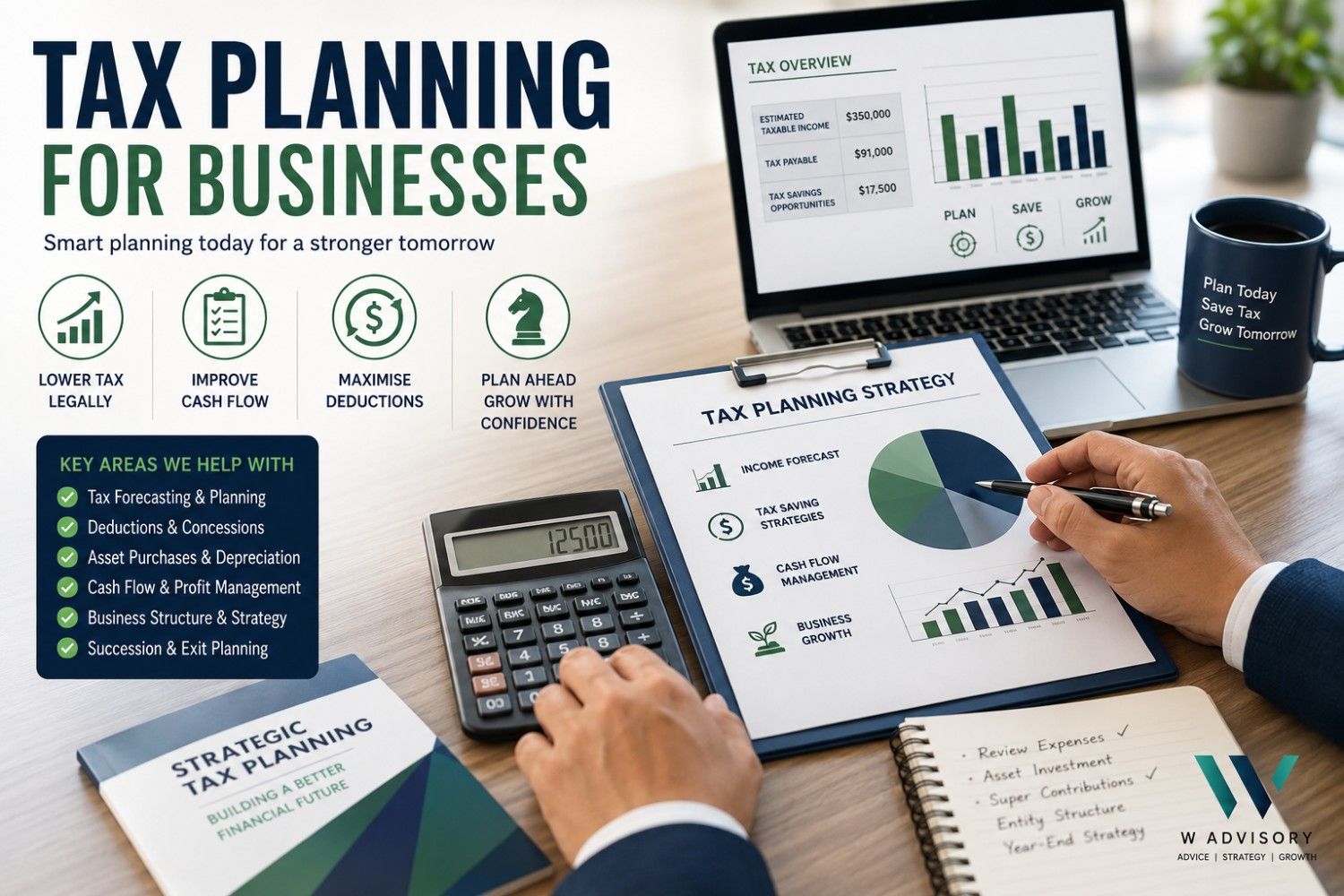
Tax Planning for Businesses

• July 14, 2026

Featured Image

Tax planning for businesses is not simply about finding deductions shortly before the end of the financial year. It is an ongoing process of understanding your financial position, forecasting future tax obligations and making informed business decisions at the right time.

Effective business tax planning can help you manage cash flow, avoid unexpected liabilities and assess whether available tax concessions are relevant to your circumstances. It may also support important decisions involving business assets, superannuation, employee costs, profit distribution, investment and succession planning.

However, tax planning must be based on current legislation, accurate financial records and the commercial needs of the business. A strategy that reduces tax in the current year may not necessarily produce the best long-term outcome.

Working with an experienced adviser throughout the year can help business owners move from reactive tax compliance to proactive financial planning.

What Is Business Tax Planning?

Business tax planning is the process of reviewing a business’s income, expenses, structure, assets and expected transactions to understand its potential tax position before key decisions or reporting deadlines occur.

It may involve:

  • Forecasting taxable income
  • Estimating company or personal tax obligations
  • Reviewing deductible business expenses
  • Planning the timing of eligible expenditure
  • Assessing depreciation and asset purchases
  • Reviewing employee and superannuation obligations
  • Considering profit distributions
  • Evaluating available business concessions
  • Preparing for the sale or transfer of business assets
  • Managing cash flow for future tax payments

The objective is not to avoid tax. It is to ensure the business meets its obligations while making legitimate, commercially sound decisions under Australian tax law.

Why Is Tax Planning Important for Businesses?

Without regular tax planning, business owners may not understand their likely tax liability until their accounts and tax return are prepared. By then, some planning opportunities may no longer be available.

A proactive approach provides several potential benefits.

Greater Cash-Flow Certainty

Tax payments can place pressure on a business when they have not been properly forecast.

Regular planning can help estimate:

  • Income tax liabilities
  • PAYG instalments
  • GST obligations
  • Employee superannuation payments
  • Payroll-related expenses
  • Other upcoming financial commitments

This gives the business time to allocate funds and reduce the risk of using cash reserved for tax to cover other operating expenses.

Better Business Decisions

Tax is only one factor in a business decision, but it can materially affect the overall cost and timing of a transaction.

For example, before purchasing equipment, hiring an employee, paying a dividend or selling an asset, a business owner should understand the likely tax, cash-flow and commercial consequences.

Reduced End-of-Year Pressure

Tax planning completed throughout the year gives the adviser and business owner more time to identify missing records, investigate unusual transactions and address potential compliance issues.

Access to Relevant Concessions

Eligible businesses may have access to a range of tax concessions, but each concession has its own eligibility conditions, including different aggregated turnover requirements. Eligibility should therefore be checked each year rather than assumed.

Key Tax Planning Strategies for Australian Businesses

The right tax planning strategies will vary depending on the business structure, turnover, industry, profitability and future objectives. The following areas commonly form part of a business tax planning review.

1. Forecast Your Taxable Income

The first step is to estimate the business’s likely financial position for the full income year.

A forecast may consider:

  • Revenue recorded to date
  • Expected sales before year-end
  • Recurring operating expenses
  • Payroll and superannuation costs
  • Planned asset purchases
  • Finance expenses
  • Depreciation
  • Capital gains or losses
  • Previous-year tax losses
  • One-off transactions

This forecast provides a starting point for estimating the potential tax liability and assessing possible strategies.

It is important to use realistic figures. Overly optimistic or incomplete forecasts can lead to poor decisions and insufficient cash reserves.

2. Review Business Deductions

Australian businesses can generally claim deductions for expenses incurred in carrying on the business where those expenses are directly related to earning assessable income.

Potential deductions may include day-to-day operating expenses, purchases of business products or services and certain capital or depreciating asset expenses. The timing and method of claiming a deduction can depend on the nature of the expense.

Common business expenses that may require review include:

  • Rent and premises costs
  • Advertising and marketing
  • Insurance
  • Professional fees
  • Software subscriptions
  • Telephone and internet expenses
  • Business travel
  • Motor vehicle expenses
  • Employee salaries
  • Contractor payments
  • Interest on business borrowings
  • Repairs and maintenance
  • Training related to the business
  • Home-based business expenses

An expense should not be claimed simply because it was paid from a business account. It must have the required connection to the business, and private portions generally need to be excluded.

Supporting records should be retained for all material claims.

3. Consider the Timing of Income and Expenses

The timing of income and expenditure may affect the year in which an amount is assessable or deductible.

Depending on the business’s accounting method and circumstances, an adviser may review:

  • When income is derived
  • Whether expenses have been incurred
  • Whether work has been completed
  • Whether deposits represent assessable income
  • Whether expenditure is revenue or capital in nature
  • Whether prepaid expenses are immediately deductible
  • When an asset is first used or installed ready for use

Business owners should not artificially manipulate invoices or transactions to obtain a tax outcome. Any timing strategy must reflect the actual arrangement and comply with the relevant tax rules.

A commercial decision should also not be made solely to obtain a deduction. Spending one dollar to reduce taxable income rarely saves one dollar in tax.

4. Review Asset Purchases and Depreciation

Asset purchases are often an important part of small business tax planning.

For the 2025–26 income year, the ATO states that eligible businesses with aggregated annual turnover below $10 million may be able to immediately deduct the business portion of eligible assets costing less than $20,000. The asset must have been first used or installed ready for use between 1 July 2025 and 30 June 2026, and the threshold applies on a per-asset basis.

Before purchasing an asset, consider:

  • Whether the asset is genuinely needed
  • The full purchase and financing cost
  • Whether it will improve productivity or revenue
  • When it will be delivered and ready for use
  • The percentage of business use
  • Whether an immediate deduction is available
  • Whether the cost must instead be depreciated
  • The GST treatment of the purchase

An immediate deduction can improve the current-year tax position, but it does not make an unnecessary purchase financially worthwhile.

Rules and thresholds can change, so current eligibility should always be verified before acting.

5. Review Employee Superannuation Payments

Businesses can generally claim deductions for salaries and wages paid to employees.

A deduction may also be available for superannuation contributions made on time to a complying super fund for employees and certain eligible contractors. Late superannuation payments may have different tax consequences and can create additional compliance costs.

Before year-end, businesses should review:

  • Outstanding employee superannuation
  • Payment processing times
  • Correct superannuation fund details
  • Employee and contractor classifications
  • Payroll records
  • Salary sacrifice arrangements
  • Deductibility timing

Making a payment on the final day may not mean the contribution is received by the fund within the required period. Processing time should be considered.

From a broader planning perspective, business owners may also wish to discuss their personal superannuation contribution strategy with an appropriately qualified adviser.

6. Check Your Company Tax Rate

The applicable tax rate is an important consideration for companies.

The general company tax rate is 30%. Companies that satisfy the requirements to be treated as base rate entities may qualify for the 25% company tax rate.

Eligibility is not based solely on turnover. The business must also consider requirements relating to base rate entity passive income.

The ATO has warned that artificial or contrived arrangements intended to access the lower company tax rate can attract attention.

Companies should confirm their status each year and ensure the correct rate is also considered when dealing with franking credits and shareholder distributions.

7. Plan Dividends and Profit Distributions Carefully

For companies, trusts and other privately owned business structures, the way profits are distributed can create important tax and cash-flow consequences.

A review may include:

  • Whether the business has sufficient cash to fund a distribution
  • The availability of franking credits
  • The company’s applicable tax rate
  • Shareholder marginal tax rates
  • Trust distribution requirements
  • Beneficiary entitlements
  • Existing shareholder or director loan accounts
  • Documentation and timing requirements
  • Division 7A considerations

A tax-effective distribution is not automatically the best commercial decision. The business may need to retain profits to fund employees, inventory, expansion, debt reduction or future investments.

Trust distributions and private company payments can involve complex rules. They should be planned and documented with professional guidance before relevant deadlines.

8. Review Bad Debts and Unrecoverable Income

Businesses using accrual accounting may have recognised income from invoices that remain unpaid.

Before year-end, review outstanding debtors and identify amounts that may be genuinely unrecoverable.

To support a bad debt deduction, the business may need to demonstrate that:

  • The amount was previously included in assessable income
  • The debt genuinely exists
  • Reasonable recovery action was considered or taken
  • The debt has been written off in the accounting records
  • The write-off occurred within the relevant income year

Merely creating an accounting provision for doubtful debts may not satisfy the requirements for a tax deduction.

The commercial impact should also be examined. A growing bad-debt balance may point to weaknesses in client onboarding, credit checks, invoicing or debt collection.

9. Review Trading Stock

Businesses holding inventory should conduct an appropriate stocktake and assess the value of trading stock on hand.

This may include reviewing:

  • Damaged stock
  • Obsolete products
  • Slow-moving inventory
  • Unsaleable items
  • Stock held at different locations
  • Work in progress
  • Consignment arrangements
  • Inventory system discrepancies

Different valuation methods may be available depending on the circumstances, but the method used must be permitted and supported.

Accurate inventory records are important for both tax reporting and business management. Excess inventory can tie up working capital and hide declining demand.

10. Consider Business Losses

A tax loss may potentially be carried forward and applied against future assessable income, subject to the relevant rules.

For companies, the ability to use prior-year losses may depend on satisfying tests relating to ownership or business continuity.

For sole traders and some other individuals, the non-commercial loss rules may restrict when a business loss can be applied against other income.

A tax loss is not the same as a cash loss, and an accounting loss may not equal the tax loss available. Differences may arise from depreciation, private expenses, capital items and non-deductible expenditure.

Prior-year losses should be confirmed before being included in tax forecasts.

11. Assess Small Business CGT Concessions

When selling a business or an active business asset, eligible business owners may be able to access small business capital gains tax concessions.

The four main concessions include:

  • The 15-year exemption
  • The 50% active asset reduction
  • The retirement exemption
  • The small business rollover

These concessions have detailed eligibility requirements involving turnover, net asset values, ownership periods, active asset tests, affiliates and connected entities.

The ATO has identified incorrect application of small business CGT concessions as an area of focus.

Business sale and succession planning should therefore begin well before a contract is signed. The structure and history of the business may significantly affect the available outcome.

12. Review the Business Structure

Tax planning sometimes raises the question of whether the current business structure remains appropriate.

A business may operate as a:

  • Sole trader
  • Partnership
  • Company
  • Trust
  • Combination of entities

Each structure has different implications for tax, asset protection, administration, profit distribution, succession and access to capital.

A structure that was suitable when a business began may not remain appropriate after substantial growth. However, changing structures can trigger income tax, capital gains tax, GST, duty and legal consequences.

Restructuring should never be undertaken solely because another structure appears to have a lower headline tax rate. A detailed assessment is required.

Tax Planning Mistakes Businesses Should Avoid

Waiting Until the Final Week of June

Some strategies require transactions, payments or documentation to be completed before the financial year ends. Starting too late can remove available options.

Focusing Only on Deductions

Tax planning should also consider cash flow, business structure, risk, asset ownership, financing, succession and future profitability.

Purchasing Unnecessary Assets

A deduction only offsets part of an expense. The business still bears the remaining cost.

Mixing Personal and Business Expenses

Poor separation creates bookkeeping problems, increases compliance risk and makes forecasting less reliable.

Relying on Outdated Tax Information

Tax rates, thresholds, concessions and administrative guidance can change. Strategies should be checked against current requirements.

Ignoring Documentation

A tax outcome must be supported by records, agreements, resolutions, invoices and evidence of the underlying transaction.

Using Unqualified Advice

Tax agent and tax advice services are regulated. Generally, a person or entity charging for tax agent services must be appropriately registered. The Tax Practitioners Board maintains a public register that businesses can use to check a practitioner’s status.

When Should Business Tax Planning Begin?

Tax planning should occur throughout the year, not only in June.

A practical schedule may include:

Monthly Reviews

Review bookkeeping accuracy, tax reserves, payroll, superannuation and outstanding debtors.

Quarterly Reviews

Assess business activity statements, PAYG instalments, profitability, cash flow and changes to the annual forecast.

Mid-Year Review

Compare actual results with the budget and identify significant differences.

Pre-Year-End Planning

Complete a detailed tax forecast and review suitable strategies while there is still time to act.

Post-Year-End Review

Assess the final result, improve internal systems and establish priorities for the next financial year.

Businesses should also seek advice before major events, including buying or selling assets, changing ownership, taking on investors, restructuring or selling the business.

How W Advisory Can Help With Business Tax Planning

Effective tax planning requires more than a checklist of deductions. It requires a clear understanding of the business’s financial position, structure, cash-flow needs and future plans.

W Advisory can work with business owners to review their financial information, estimate potential tax obligations and identify areas requiring attention before key decisions are made.

A business tax planning review may include:

  • Taxable income forecasting
  • Business deduction reviews
  • Cash-flow planning
  • Company tax rate assessments
  • Asset purchase considerations
  • Superannuation payment reviews
  • Profit and distribution planning
  • Business structure discussions
  • CGT and succession planning considerations
  • Coordination with broader accounting and advisory requirements

By planning earlier, business owners can approach tax obligations with greater confidence and make decisions that support both compliance and long-term commercial objectives.

Frequently Asked Questions

What is the best tax planning strategy for a small business?

There is no single strategy that is suitable for every business. The appropriate approach depends on the business structure, turnover, profitability, cash flow, assets and future plans. A tax forecast and review of the business’s individual circumstances should come first.

How can a business legally reduce its tax?

A business may be able to manage its tax through legitimate deductions, appropriate timing of eligible expenses, depreciation, superannuation payments, available concessions and careful transaction planning. Every strategy must comply with current tax law and be properly documented.

When should business tax planning start?

Tax planning should take place throughout the financial year. A more detailed review is generally useful several months before year-end, giving the business time to act before relevant deadlines.

Are all business expenses tax-deductible?

No. Expenses generally need to be incurred in carrying on the business and connected to earning assessable income. Private, domestic, capital and specifically non-deductible expenses may receive different treatment.

Can I buy equipment to reduce my business tax?

An eligible asset purchase may produce a deduction or depreciation claim, but the asset should be commercially necessary. The timing, cost, business-use percentage and current tax rules must be reviewed before making the purchase.

What is the company tax rate in Australia?

The general company tax rate is 30%. Eligible base rate entities may qualify for a 25% rate. Eligibility should be checked each year because turnover is not the only relevant requirement.

Can a business claim employee superannuation contributions?

A deduction is generally available for eligible employee and certain contractor superannuation contributions paid on time to a complying superannuation fund. Late payments can have different tax and compliance consequences.

What records are needed for business tax deductions?

Businesses should maintain invoices, receipts, bank statements, contracts, payroll records, asset registers, logbooks and other evidence showing the amount, business purpose and date of each transaction.

What happens if my business makes a tax loss?

The loss may potentially be carried forward or applied under relevant rules. Eligibility depends on the business structure and circumstances. Tax losses should be confirmed before being included in future planning.

Do I need a tax adviser for business tax planning?

Professional advice is particularly valuable when a business has employees, multiple entities, significant assets, trust or company distributions, prior-year losses, restructuring plans or an upcoming business sale.

Disclaimer

This guide provides general information only and does not constitute tax, financial or legal advice. Tax rules and eligibility requirements vary according to individual circumstances. Seek advice from an appropriately qualified professional before implementing a tax planning strategy.


Other Blogs

How-to-Use-AI-in-Tax-Planning-for-Clients

How to Use AI in Tax Planning for Clients

Artificial intelligence is changing how businesses analyse financial information, forecast tax obligations and prepare for important decisions. For accountants and advisers, AI can reduce repetitive work, identify patterns across large datasets and support more proactive conversations with clients. However, effective tax planning is not simply a matter of entering financial information into an AI tool …

2026 Federal Budget tax changes

2026 Federal Budget Tax Changes Explained for Businesses and Investors

The 2026 Australian Federal Budget introduced a wide range of tax measures that may affect businesses, investors, property owners, sole traders, start-ups, family groups and trustees over the next few years. For business owners, the Budget includes measures designed to improve cash flow, support investment and reduce some compliance pressure. For investors, the most talked-about …

Featured Image
We will help business owners and
professionals overcome the burden of
poor tax advice, and inefficient structures

by delivering tailored strategies
that are compliant, minimise tax
and are structured to create
generational wealth.

Call Us Book Free Consultation