...

A Step-by-Step Guide to Bank Reconciliation for Small Businesses

• August 20, 2026

Featured Image

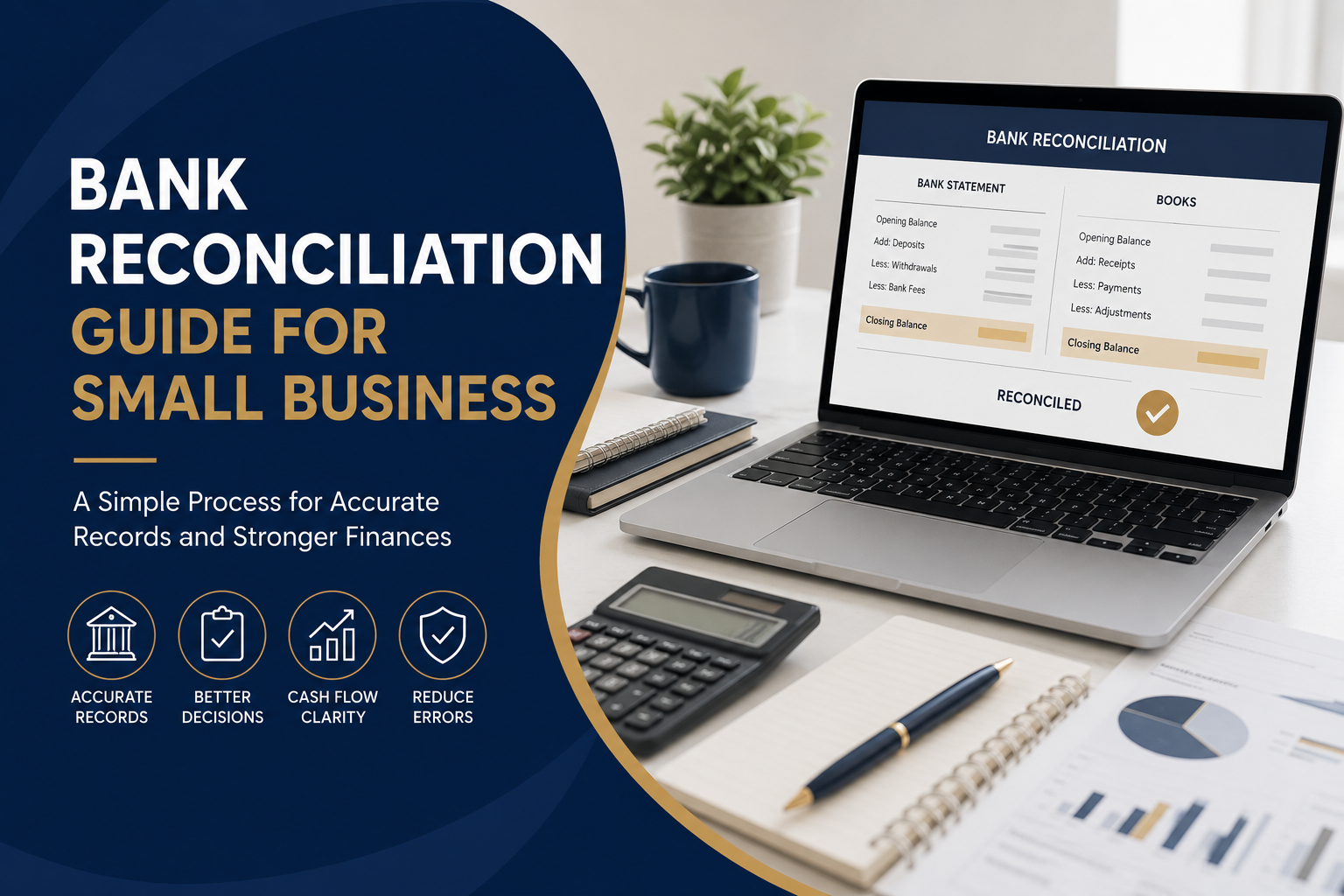
Keeping your financial records accurate is essential for understanding business performance, managing cash flow and preparing reliable accounts. One important bookkeeping process is bank reconciliation, often referred to as bank recon.

A bank reconciliation compares the transactions recorded in your accounting system with the transactions shown on your business bank statement. The aim is to identify missing entries, duplicates, incorrect amounts, unpresented payments or other differences so your records accurately reflect what has moved through your bank account.

For Australian small businesses, regular reconciliation can help maintain accurate business and GST records. The Australian Taxation Office (ATO) recommends that businesses regularly reconcile their records so they understand what money has moved through their accounts and why.

This guide explains how bank reconciliation works, why it matters and how small businesses can build a more reliable reconciliation process.

What Is Bank Reconciliation?

Bank reconciliation is the process of comparing your internal accounting records with your bank statement and resolving any differences between the two.

For example, your accounting software might show that you paid a supplier, but the payment may not yet appear on your bank statement. Alternatively, a bank fee may appear on the statement but may not yet have been entered into your accounting system.

A bank recon helps identify these differences and bring sets of records into agreement.

Regular reconciliation can give business owners greater confidence that the financial information they are using is complete and up to date.

Why Is Bank Reconciliation Important for Small Businesses?

Bank reconciliation helps ensure your accounting records accurately reflect the money moving through your business accounts.

Regular reconciliation can help with:

  • More accurate financial reporting
  • Better cash-flow visibility
  • Identification of missing transactions
  • Detection of duplicate entries
  • Identification of unexpected bank charges
  • Cleaner bookkeeping records
  • More accurate GST reporting
  • Easier BAS preparation

The ATO notes that banking records form an essential part of business records because they show money coming into and going out of the business.

Without regular reconciliation, small errors can remain unnoticed and accumulate over time.

How to Do a Bank Reconciliation: Step by Step

The exact process can differ depending on your accounting software and bookkeeping setup, but the basic principles remain the same.

Step 1: Gather Your Bank and Accounting Records

Start by making sure you have the records needed for the reconciliation period.

These may include:

  • Bank statements
  • Accounting software transaction reports
  • Sales invoices
  • Supplier bills
  • Receipts
  • Merchant or EFTPOS records
  • Loan transactions
  • Bank fee records
  • Interest transactions
  • Expense documentation

Choose a clear reconciliation period, such as a month, and make sure the opening and closing dates in your accounting records match the bank statement.

Step 2: Confirm the Opening Balance

Before matching individual transactions, confirm that the opening balance in your accounting records agrees with the reconciled closing balance from the previous period.

If the opening balances do not agree, there may be an unresolved difference from an earlier reconciliation.

This should be investigated before continuing.

Starting with an incorrect opening balance can make the entire bank recon more difficult and can cause the discrepancy to carry forward into later periods.

Step 3: Match Money Received

Next, compare deposits and other incoming payments shown on the bank statement with amounts recorded in your accounting system.

Common incoming transactions include:

  • Customer payments
  • Online sales
  • EFTPOS settlements
  • Direct deposits
  • Refunds
  • Interest received
  • Owner contributions

Check the date, amount and transaction description.

In some cases, several customer payments may be combined into one bank deposit, so you may need to trace the payment back to individual invoices or merchant records.

Step 4: Match Business Payments

Compare money leaving the bank account with payments recorded in your accounting system.

These might include:

  • Supplier payments
  • Rent
  • Utilities
  • Software subscriptions
  • Insurance
  • Payroll-related transactions
  • Loan repayments
  • Equipment purchases
  • Business expenses
  • Bank charges

Check that each transaction has been recorded once and allocated to the appropriate account.

Step 5: Identify Transactions Missing From Your Books

Your bank statement may contain transactions that have not yet been entered into your accounting software.

Common examples include:

  • Bank fees
  • Merchant fees
  • Interest
  • Direct debits
  • Automatic subscriptions
  • Loan payments
  • Refunds
  • Electronic payments

These transactions need to be reviewed and recorded appropriately.

Avoid simply creating entries to force the reconciliation to balance. The objective is to understand and correctly account for each difference.

Step 6: Look for Transactions Recorded Twice

Duplicate transactions can occur when an expense has been entered manually and then imported again through a bank feed.

Look for identical:

  • Dates
  • Amounts
  • Suppliers
  • Reference numbers
  • Descriptions

Removing confirmed duplicate entries can help bring the accounting balance back in line with the bank statement.

However, make sure the entries genuinely are duplicates before deleting anything.

Step 7: Investigate Outstanding Transactions

Sometimes a transaction has been correctly recorded in your accounting system but has not yet appeared on the bank statement.

This may occur with transactions that have not yet cleared.

Depending on the circumstances, these could include outstanding payments or deposits that are still being processed.

They should be reviewed rather than immediately treated as an error.

If an item remains outstanding for an unusually long time, it may require further investigation.

Step 8: Review Differences Carefully

If your accounting balance and bank statement still do not agree, work through the transactions systematically.

Common causes include:

  • Incorrect amounts
  • Incorrect transaction dates
  • Duplicate entries
  • Missing transactions
  • Transactions allocated to the wrong bank account
  • Bank charges not recorded
  • Payments entered but never processed
  • Deposits recorded incorrectly
  • Opening balance errors

Trying to locate a discrepancy by randomly changing transactions can create additional bookkeeping problems.

A structured review is usually more effective.

Step 9: Confirm the Reconciled Balance

Once all legitimate differences have been accounted for, your adjusted accounting balance should agree with the relevant bank statement balance.

At this point, complete or finalise the reconciliation within your accounting system.

Retain appropriate supporting records in line with your business’s record-keeping requirements.

The ATO requires businesses to keep records that support their income, expenses and GST reporting, with the required retention period depending on the type of record.


How Often Should a Small Business Do Bank Reconciliation?

For many small businesses, bank reconciliation should be performed regularly rather than being left until the end of the financial year.

The appropriate frequency depends on transaction volume and the complexity of the business.

Depending on transaction volume, a business may reconcile:

  • Daily
  • Weekly
  • Fortnightly
  • Monthly

A business processing a large number of daily transactions may benefit from more frequent reconciliation than a business with relatively few transactions.

The ATO’s small-business guidance includes monthly bank reconciliation as part of good bookkeeping practices and encourages businesses to regularly check that records match their bank accounts.

Regular reconciliation also makes discrepancies easier to investigate because transactions are still recent.

What Is GST Reconciliation?

GST reconciliation involves checking whether GST has been recorded and classified correctly for the underlying business transactions and reporting period.

For a GST-registered small business, accurate transaction coding helps ensure the GST information used for BAS reporting is based on correctly recorded transactions..

A GST reconciliation may include reviewing:

  • GST on sales
  • GST on purchases
  • Transactions coded without GST
  • Private or non-business expenses
  • Adjustments
  • Tax invoices
  • Incorrect GST classifications
  • Transactions entered into the wrong reporting period

The ATO advises businesses to keep records that contain enough information to support amounts included on activity statements and tax returns and to check that relevant tax invoices are valid.

What Is the Difference Between Bank Reconciliation and GST Reconciliation?

Bank reconciliation and GST reconciliation are related, but they are not the same process.

Bank reconciliation checks whether transactions in the accounting records match the bank account.

GST reconciliation focuses on whether GST has been recorded and classified correctly for relevant transactions and reporting.

A transaction can be correctly matched during a bank reconciliation but still contain an incorrect GST treatment.

For example, an expense may have been correctly recorded for the exact amount paid but coded to an incorrect GST category.

This is why businesses should not assume that completing their bank reconciliation automatically means their GST records are correct.

How Does Bank Reconciliation Help With BAS Preparation?

A completed bank recon can provide a cleaner foundation for BAS preparation by helping confirm that income and expenditure transactions have been captured in the accounting system.

This can help identify:

  • Missing sales
  • Missing expenses
  • Duplicate transactions
  • Incorrect bank allocations
  • Transactions that require GST review
  • Personal transactions paid through business accounts

For eligible small businesses using Simpler BAS, the key GST reporting labels generally include total sales, GST on sales and GST on purchases.

Accurate bookkeeping and regular reconciliation can therefore help reduce the risk of preparing activity statements using incomplete or inconsistent records.

Common Bank Reconciliation Problems Small Businesses Face

Missing Transactions

Bank charges, automatic payments and merchant fees can easily be overlooked when bookkeeping is not kept up to date.

Regular reconciliation makes these items easier to identify and investigate.

Duplicate Entries

Bank feeds can make bookkeeping more efficient, but duplicate entries may occur if the same transaction is also manually entered.

Personal Expenses in the Business Account

Business and personal transactions should be clearly distinguished.

The ATO specifically notes that reconciliation can help identify private expenses paid through a business account that may need to be excluded when preparing tax records.

Keeping business and personal transactions separate can make reconciliation and record-keeping much easier.

Incorrect Transaction Coding

A transaction can reconcile correctly to the bank but still be allocated to the wrong accounting category.

This may affect management reports, GST treatment or the information later used by your accountant.

Unexplained Balance Differences

A small unexplained difference should not automatically be ignored.

Even a minor discrepancy may indicate a larger bookkeeping issue such as incorrect dates, duplicated entries or a missing transaction.

Bank Feeds Do Not Replace Bank Reconciliation

Many cloud accounting platforms automatically import transactions using bank feeds.

This can save time, but automatic importing does not remove the need for reconciliation.

A bank feed imports transaction information into your accounting system, but it does not confirm that the transaction has been correctly matched, classified or reviewed.

It does not necessarily confirm:

  • What the transaction relates to
  • Whether it was entered previously
  • Whether the GST treatment is correct
  • Whether the expense is business or private
  • Whether it has been allocated to the right account

Review is still required to confirm that transactions have been correctly matched, classified and recorded.

Businesses should use automation to improve the reconciliation process rather than assuming automation eliminates the need for oversight.

What Are Bank Reconciliation Services?

Bank reconciliation services involve having a bookkeeper, accountant or financial advisory team regularly review and reconcile business bank accounts against accounting records.

Depending on the engagement, the service may include:

  • Matching bank transactions
  • Identifying missing entries
  • Reviewing duplicates
  • Investigating discrepancies
  • Checking transaction coding
  • Reviewing unreconciled items
  • Cleaning up historical records
  • Supporting BAS preparation
  • Reviewing GST treatment
  • Producing more reliable financial reports

For businesses where bookkeeping has fallen behind, professional reconciliation can also help identify where historical records need to be corrected.

When Might a Business Need Bank Reconciliation Solutions?

Different businesses need different bank reconciliation solutions.

A small business may benefit from additional support where:

  • Transaction volumes are increasing
  • Multiple bank accounts are being used
  • Records are regularly falling behind
  • The business has frequent unreconciled transactions
  • GST coding is inconsistent
  • BAS preparation takes too long
  • Management reports do not appear reliable
  • Bank and accounting balances rarely agree
  • The owner is spending too much time fixing bookkeeping

The right solution may involve improving the existing bookkeeping workflow, adjusting accounting software processes or obtaining ongoing professional support.

Bank Reconciliation Best Practices for Small Businesses

Reconcile Regularly

Avoid allowing months of transactions to accumulate before reconciling the account.

Frequent reconciliation makes errors easier to identify and resolve.

Keep Supporting Documents

Maintain invoices, receipts and supporting information for business transactions.

Keeping supporting documents makes unusual or disputed transactions easier to investigate.

Keep Business and Personal Banking Separate

Separating personal and business activity makes reconciliation cleaner and reduces confusion when preparing financial and tax records.

Review GST Coding

A transaction matching the bank statement does not necessarily mean it has been given the correct GST treatment.

Review questionable transactions before finalising reporting.

Investigate Unusual Transactions

Unexpected withdrawals, duplicate payments or unfamiliar transactions should be investigated promptly.

Review Old Unreconciled Items

Transactions that remain unreconciled for extended periods should not simply stay in the accounting system indefinitely.

Determine why they have not cleared or whether they were entered incorrectly.

Avoid Creating Artificial Adjustments

A reconciliation should explain the difference between the accounting records and bank statement.

Creating an unexplained adjustment purely to make the numbers agree defeats the purpose of the process.

Can Bank Reconciliation Help Improve Cash-Flow Visibility?

Yes. Regular reconciliation helps ensure your accounting records contain current and complete transaction information.

This can make financial reports more useful when assessing:

  • Cash available
  • Upcoming obligations
  • Customer payments
  • Supplier payments
  • Operating expenses
  • Business performance

If the underlying bookkeeping is inaccurate, management reports can also become misleading.

Bank reconciliation therefore forms part of the foundation for more reliable financial decision-making.

Signs Your Bank Reconciliation Process Needs Attention

Your reconciliation process may need improvement if:

  • Your accounting balance regularly differs from the bank
  • Transactions remain unreconciled for months
  • BAS preparation requires extensive corrections
  • You repeatedly find duplicate transactions
  • Business and personal expenses are mixed together
  • GST codes are frequently changed at the last minute
  • Financial reports do not make sense
  • Important transactions are often missing
  • Reconciliation is only performed at year-end

These signs do not necessarily indicate a serious problem, but they may show that your bookkeeping and reconciliation process needs closer review.

How W Advisory Can Help With Bank Reconciliation

Regular bank reconciliation is an important part of maintaining accurate financial records and giving business owners greater confidence in the information they use to run their business.

W Advisory can help small businesses maintain organised financial records through accounting, bookkeeping and reconciliation support.

Depending on your business requirements, professional support can help with:

  • Bank reconciliation
  • Reviewing unreconciled transactions
  • Bookkeeping clean-ups
  • GST reconciliation
  • Accounting record reviews
  • BAS-related bookkeeping preparation
  • Improving financial reporting processes
  • Identifying recurring reconciliation issues

Keeping your records accurate throughout the year can make reporting and financial management easier when deadlines approach.

Need Help Getting Your Business Accounts Reconciled?

If your bank balance and accounting records do not agree, transactions keep accumulating or GST reconciliation is becoming difficult to manage, it may be time to review your bookkeeping process.

Talk to W Advisory about your bank reconciliation and accounting requirements and find out how a more organised financial process can give you clearer, more reliable business records.

Frequently Asked Questions About Bank Reconciliation

What is bank reconciliation in simple terms?

Bank reconciliation is the process of comparing the transactions in your accounting records with your bank statement. Any differences are investigated and corrected so the records accurately reflect the money that has moved through the bank account.

How often should a small business complete a bank recon?

The right frequency depends on transaction volume and business complexity. Some businesses reconcile monthly, while businesses with larger transaction volumes may benefit from weekly or even more frequent reconciliation.

Is GST reconciliation the same as bank reconciliation?

No. Bank reconciliation checks whether accounting transactions match the bank account, while GST reconciliation checks whether GST has been correctly recorded and classified. A transaction can reconcile to the bank while still having an incorrect GST treatment.

Why does my bank balance not match my accounting software?

Common causes include missing transactions, duplicate entries, bank charges, outstanding payments, incorrect dates, opening balance errors or transactions allocated to the wrong account. Each difference should be investigated before finalising the reconciliation.

Do bank feeds automatically reconcile accounts?

Bank feeds can automatically import transactions, but they do not remove the need for reconciliation. Transactions still need to be matched, reviewed and correctly classified.

When should a business consider bank reconciliation services?

Professional support may be useful when bookkeeping is behind, balances frequently do not agree, transaction volumes are increasing, GST coding is inconsistent or reconciliation is taking significant time away from running the business.


Disclaimer:

 This guide provides general information only and does not constitute accounting, tax or financial advice. Your obligations and circumstances may differ, so consider seeking advice from a qualified professional before acting on the information provided.

Other Blogs

outsourced bookkeeping

10 Questions to Ask Outsourced Bookkeeping Providers in 2026

Choosing an outsourced bookkeeping provider in 2026 involves more than finding someone who can reconcile bank accounts and process transactions. Australian businesses increasingly rely on cloud accounting platforms, automated workflows, integrated systems and remote finance teams. This can make bookkeeping more efficient, but it also means businesses should carefully consider data security, quality control, communication, …

how-to-reduce-taxable-income-in-Australia

How to Reduce Taxable Income in Australia

Reducing taxable income in Australia is not about hiding income, making risky claims or chasing aggressive tax schemes. It is about understanding the deductions, structures and tax planning strategies you are legally entitled to use. For individuals, this may include work-related deductions, personal super contributions, work-from-home expenses, investment costs and charitable donations. For business owners, …

Featured Image
We will help business owners and
professionals overcome the burden of
poor tax advice, and inefficient structures

by delivering tailored strategies
that are compliant, minimise tax
and are structured to create
generational wealth.

Call Us Book Free Consultation
Seraphinite AcceleratorOptimized by Seraphinite Accelerator
Turns on site high speed to be attractive for people and search engines.